
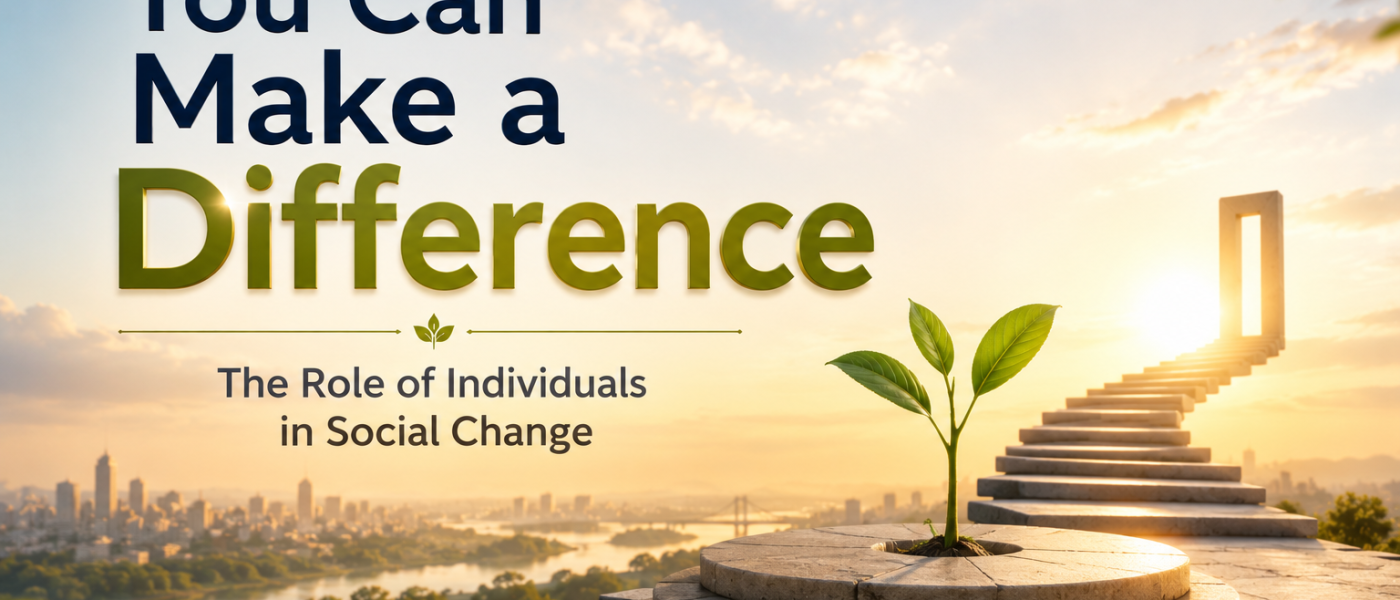
The Myth of the "Too Small to Matter" Mindset
Picture this: a young woman sitting at the back of a public bus in Montgomery, Alabama, in 1955. Tired after a long day of work, she refuses to give up her seat to a white passenger. That single act of quiet defiance — by Rosa Parks, a seamstress, not a president or a general ignited one of the most powerful civil rights movements the world has ever seen.
Now ask yourself: Have you ever dismissed your own potential to create change because you felt “too ordinary”? If yes, you are not alone and you are also, frankly, mistaken.
The belief that social change only happens through governments, wealthy institutions, or historical giants is one of the most paralysing myths of our time. The truth, backed by sociology, history, and lived experience, is far more empowering: the role of individuals in social change is not supplementary it is foundational.
This article will unpack what social change actually means, the different types it comes in, the four distinct roles individuals play within it, and most importantly the concrete, practical ways you can begin making a difference in society starting today.

What Is Social Change? A Clear Definition
Social change refers to the significant alteration of mechanisms within the social structure — shifts in cultural symbols, rules of behaviour, social organisations, and value systems. It is the evolution of how people live, relate, and govern themselves over time.
Social change is rarely a single dramatic moment. More often, it is a quiet accumulation of voices, choices, and actions by countless individuals — until the weight of collective will tips a society toward a new normal.
Types of Social Change — Explained in a Unique Way
Think of society as a river. Sometimes it shifts course gradually; sometimes a dam breaks and everything changes overnight. Here are the main types of social change, mapped to that metaphor:
1. Evolutionary Change
Like a river slowly carving a canyon, evolutionary change unfolds over generations. Think of shifting attitudes toward gender equality, environmental consciousness, or workplace rights. No single event defines it — it is the cumulative effect of millions of individual choices and conversations over decades
2. Revolutionary Change
When a dam breaks, everything changes fast. Revolutionary change is sudden, often disruptive, and challenges existing power structures at their core. The French Revolution, India’s independence movement, and the Arab Spring are textbook examples. These revolutions began not in palaces, but in the minds of frustrated, visionary individuals.
3. Structural Change
This involves reforming the institutions that organise society — legal systems, economic models, and educational frameworks. When individuals advocate for policy reform, challenge discriminatory laws, or build new institutions, they drive structural change. It is arguably the most durable form.
4. Cultural Change
Perhaps the most underestimated type. Cultural change is the reshaping of shared values, norms, language, and beliefs. Artists, writers, teachers, and storytellers are often the most powerful agents of cultural change — reshaping how an entire society thinks about itself.
5. Technological Change
From Gutenberg’s printing press to the internet, technology has reshaped social relationships, economic opportunity, and the flow of information. Individuals who build, democratise, or challenge technology are deeply embedded in this form of change.

The Role of Individuals in Social Change
Sociology has long debated whether it is “great individuals” or “historical forces” that drive change. The honest answer is: both, but individuals ignite the spark.
As Max Weber observed, charismatic individuals who give voice to deep collective aspirations can redirect the course of history. But they only succeed when their vision resonates with what a society is quietly ready for. The individual does not create change alone — they translate the unspoken need of the many into visible action.
The Four Roles of a Change Agent
Civil rights scholar Bill Moyers identified four distinct social change roles that individuals can inhabit. Understanding which one fits you is the first step toward effective action:
The Helper
Sees individuals in need and responds personally. Volunteers, caregivers, and community service workers. Their power lies in direct, compassionate action.
The Advocate
Sees broken systems and pushes institutions to change. Lawyers, policy workers, journalists, and lobbyists. They bridge people and power.
The Organizer
Builds collective power by connecting individuals into movements. Community organizers, union leaders, and campaign managers. Strength in numbers.
The Rebel
Sees individuals in need and responds personally. Volunteers, caregivers, and community service workers. Their power lies in direct, compassionate action.
The Pioneer Effect: How One Person Lights the Path
There is something uniquely powerful about being first. A pioneer does not just act — they reveal that action is possible. When one person demonstrates that a new way of being is achievable, it permits everyone watching.
This is the multiplier effect of individual action. One person’s courage makes it safer for ten more. Those ten inspire a hundred. And a hundred can reshape a nation.

“The role of the pioneer is vital to social change, because the next stage of social progress almost always remains unseen by the collective. It is the free-thinking, far-seeking individual who dares to imagine what the popular mind is unaware of.”
Real-World Examples That Prove One Person Changes Everything
History is not made by abstractions. It is made by people. Consider these defining examples of individual action creating seismic social change:
Malala Yousafzai — Education as Defiance
A teenage girl from Pakistan’s Swat Valley, shot by the Taliban for going to school, became the youngest Nobel Peace Prize laureate and a global symbol for girls’ education. She did not start with resources or power. She started with conviction.
Dr. B.R. Ambedkar — Rewriting the Rules
Born into a caste that was deemed untouchable, Ambedkar went on to earn doctorates from Columbia and LSE, draft India’s Constitution, and fundamentally dismantle legal discrimination in an entire nation. His individual journey became a national transformation.
Wangari Maathai — Planting Change
A Kenyan professor who started planting trees with rural women as a form of environmental and political protest. Her Green Belt Movement planted over 47 million trees. She won the Nobel Peace Prize in 2004 for planting trees and empowering women. Simultaneously.
These examples are not meant to be intimidating. They are meant to be illuminating. Each of these individuals started small, started local, and stayed consistent. That is the blueprint.
How You Can Make a Difference in Society — Right Now
You do not need a Nobel Prize, a foundation, or a million followers. You need a starting point and a sustained commitment. Here are the most impactful, practical ways individuals can drive social change today:
- Educate Yourself and Share That Knowledge. Social change begins with awareness. Read, listen, and then teach. Share reliable information within your circle. One informed person in a community can shift how ten more people think about an issue.
- Vote — and Vote Locally. National elections matter, but local elections shape your daily life most directly. School boards, municipal councils, and local policy-makers are far more accessible to individual influence than national leaders.
- Volunteer With Intention. Choose causes aligned with your skills. A teacher volunteering for literacy programs, an engineer building clean water systems, or a doctor running health camps — skill-aligned volunteering multiplies impact exponentially.
- Support Ethical Businesses and Boycott Harmful Ones. Your purchasing power is a form of voting. Every rupee or dollar you spend is a vote for the world you want to live in. Consumer pressure has changed corporate policy on everything from environmental practices to labour rights.
- Use Social Media for Amplification, Not Just Expression. Do not just vent online — mobilise. Share petitions, highlight grassroots causes, and amplify voices that are not yet being heard. Social media, used wisely, is one of the most democratizing forces in history.
- Mentor One Person. Sometimes, the most profound social change happens in private — when an experienced person invests their time in someone who lacks access to opportunity. Mentorship creates generational ripple effects that no statistic can fully capture.
- Give Back — Financially, if You Can; In Every Other Way if You Cannot. Philanthropy is not the exclusive domain of the wealthy. Time, skills, attention, advocacy, and community are forms of giving that have no financial minimum.
The Inner Work: Why Your Mindset Determines Your Impact
Here is a dimension of social change that rarely gets discussed: the internal transformation required before external change can happen.
Research published in the Stanford Social Innovation Review found that social change leaders who invested in their own inner well-being — through reflective practices, therapy, meditation, or mentorship — were measurably more effective in their work. They listened better, collaborated more skillfully, and sustained their efforts longer without burnout.
This makes intuitive sense. You cannot pour from an empty vessel. The most effective change agents are not those who sacrifice themselves endlessly — they are those who sustain their vision over time, through clarity of purpose and emotional resilience.
Gandhi’s concept of satyagraha — truth-force — was rooted in exactly this understanding. To change the world, he first had to embody the world he wanted to see. Rosa Parks did not act impulsively; she had been trained in nonviolent resistance at Highlander Folk School months before her famous refusal on that bus.
Your inner life is the engine of your outer impact. Tend to it accordingly.
A Living Example
Entrepreneur · Philanthropist · Community Changemaker
The ideas in this article are not theoretical. They find a powerful, contemporary expression in the journey of Sateesh Reddy Muvva — Chairman of the Srini Group in Australia and founder of the Sri Muvva Foundation.
Born in Pedaparimi, a modest village in Andhra Pradesh, India, Sateesh arrived in Australia in the early 2000s with a student visa and a determination to build something meaningful. His first job was behind a petrol station counter. He began making small charitable donations even then — not because he had much, but because he understood that the habit of giving must precede the capacity for it.
As his business grew — through fuel retail, convenience stores, and landmark real estate projects including Signature Wollongong (the 22-storey tallest building in Wollongong, completed in 2020) — his sense of responsibility to his community grew with it. The Srini Group, today a multi-division enterprise spanning C-Retail, Petroform, MSR Developments, and philanthropy, was built on the principle that business and social good are not opposing forces.
In 2015, Sateesh established the Sri Muvva Foundation, in memory of his late mother, Muvva Hemalatha — with a single, clear goal: to give back to Pedaparimi. The Foundation installed a ₹20 lakh ozone water purification plant now serving over 10,000 people daily for an estimated 25 years. It has also funded sanitation systems, scholarships for students, and elder care facilities in the village. None of this was part of an elaborate master plan — it grew organically, project by project, out of a sense of responsibility that Sateesh refuses to call charity.
“All of the money you earn, you earn from society. You should be willing to give back, no matter how big or small your contribution. If you have a hundred dollars, try giving back a dollar. Giving doesn’t start after you succeed — it begins the moment you are willing.”
Sateesh Muvva’s story is not a story of exception. It is a story of intention. He did not wait until he had “enough” to start giving. He started with what he had and scaled. He did not limit his identity to “entrepreneur.” He chose to also be a Helper, an Advocate, and an Organizer — embodying every dimension of what it means for an individual to drive social change.
For those seeking to understand the role of individuals in social change, Sateesh’s journey is a masterclass in starting local, thinking long-term, and letting purpose precede profit.

Your Turn to Lead
Social change does not wait for the perfect person, the perfect moment, or the perfect plan. It waits for someone — anyone — to take the first honest, committed step.
History is not a record of what happened to people. It is a record of what people chose to do. Rosa Parks chose to stay seated. Ambedkar chose to study when the world told him he could not. Wangari Maathai chose to plant when the world was burning. Sateesh Muvva chose to give back when he could have simply moved forward.
The question is not whether you have the power to make a difference. You do. The question is: what will you do with it?
Start with one thing. One cause. One conversation. One act of generosity. One truth spoken aloud. The river of social change is not built by a single wave — it is built by the steady, persistent flow of millions of individuals who decided that silence was not enough.
This article was thoughtfully crafted by a dedicated team of content writers and authors from the desk of Srini Group . The Srini Group is a prominent Australian company specializing in active asset development, property management, and community projects. Founded by entrepreneur and philanthropist Sateesh Muvva, the organization operates through divisions like Petroform, MSR Developments, and the Sree Muvva Foundation.
-Team Sri Muvva Foundation
Sri Muvva Foundation, a promising NGO, was started by Sateesh Muvva (Sateesh Reddy Muvva), a visionary and proven business leader and serial entrepreneur, at his very young age. The foundation is dedicated to creating positive social impact through meaningful CSR initiatives in Andhra Pradesh and Telengana


